
5 Things
Five Lessons Learned While Reaching a Neighborhood


Years ago, I took the StrengthsFinder Assessment, which is designed to help a person understand their top gifts. “Achiever” fell at the top of my list, and I found myself feeling uncomfortable with this result. I wrestled with my uneasiness, unsure why I felt this way until God began to unlock my understanding. From the time I was young, I had built my life to be full to the brim, accumulating a long resume of accomplishments, none of which brought me satisfaction. Instead, God placed a hunger inside of me to be marked by the supernatural. One definition of supernatural is “above, beyond, and far higher and greater than the natural.” I longed to see things that exceeded what I could do through my own achievements and to witness the power of God in my daily life.
God placed a hunger inside of me to be marked by the supernatural.
Since that time, God has taught me to forsake striving and performance, instead discovering His will and wisdom by walking in friendship with Him. Even more than before, my heart yearns to experience ministry moments that inspire awe of our magnificent God. Our team had the honor of experiencing some of these moments during our summer of outreach at Asbury Park. As I share our story, I’ll also share the five lessons we learned through reaching our neighborhood.
1. We can partner with God to see His desires fulfilled.
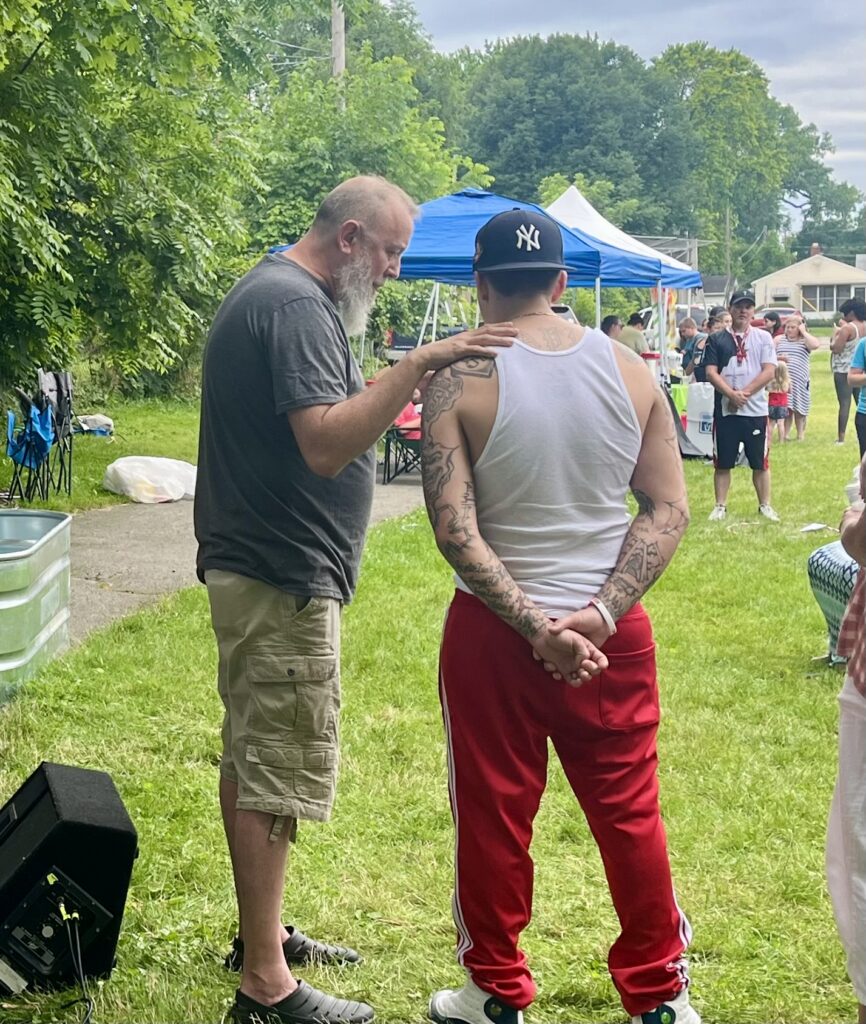
We were gathered for our regular weekly prayer meeting when God said, “I want this neighborhood. Will you make My name great at Asbury Park?” We felt the weight of this invitation. For a year, we had been hosting neighbors in the basement of our ministry house for weekly dinners. Dozens had found community and a sense of belonging in that space. Some had already met Jesus, but He wanted us to cast the net further. No one on our team had imagined taking our Thursday night dinners out to the park for the summer. But God had heard our cry: “God, you get to do whatever is in your heart to do. We pray your will be done in this region and that Jesus would be glorified.” And that day, He gave us another piece of His blueprint for our region.
2. We don’t have to strive.
Naturally, we looked at the invitation from God and imagined possibilities of how to gather the community at our neighborhood park. We considered the successes of past events that utilized raffle and prize incentives or entertainment such as bounce houses. We went back to prayer and God revealed more of His plan to us. He wanted it simple. As we prayed, He gave us visions of the stations in the park: crafts themed to tell the story of creation, food to fill bellies, a field with kids carefree and playing, bold worship, and a baptismal. He said to get ready for people to be saved and baptized!
May we all live in daily expectation of the things that are beyond what we could do in our own ability, partnering with God and watching His fame spread across the earth.
3. God has a storehouse of provision.
Although God’s plan was relatively simple, we did not have the finances or workers to pull off this vision of taking dinners to the park every other week throughout the summer. God impressed upon us that He would be faithful to provide everything we needed to serve the community in this way. We chose to embrace His plan with faith that He would make a way.
4. God loves collaboration.
God brilliantly inspired us to reach out to many individuals and groups, inviting them to partner with us in reaching the Five Points Neighborhood in Toledo. Over a dozen churches were represented by the participants who filled volunteer slots and donated food and supplies. The greater Body of Christ truly came together, unified around Jesus and His mission.
5. Love + Power + Gospel = Jesus gets His reward
When our dinners first launched at the ministry base in 2023, God gave us a foundational verse to build upon:

“Walk continually in love [that is, value one another—practice empathy and compassion, unselfishly seeking the best for others], just as Christ also loved you and gave Himself up for us, an offering and sacrifice to God [slain for you, so that it became] a sweet fragrance” (Ephesians 5:2 AMP).
God desired for this aroma to rise to Heaven, the smell of a people walking in sacrificial love. And so, His people took that love to the park. We shared the good news that Jesus gave His life so that all could be saved, healed, and delivered. Many accepted the invitation to receive this gift from Jesus, giving their lives to Him. People experienced healing in their bodies and freedom from bondage. Many encountered the power of the Holy Spirit in a personal way. Twenty-four people chose to follow Jesus through water baptism!
God rained down this summer on Asbury Park. It was His plan, His provision, His glory. It was Jesus’ reward. May we all live in daily expectation of the things that are beyond what we could do in our own ability, partnering with God and watching His fame spread across the earth.
About the Author

Sarah Williams
Sarah Williams and her husband, George, have been in ministry together since they were married in 2006. They began their journey as urban missionaries, which led to planting and co-pastoring CityLight Church. In 2016, Sarah founded the Transformation Center, where she and her team have helped hundreds of people find wholeness and freedom. Sarah’s passion is for Jesus to receive His reward through salvation, healing, and deliverance. The team at the Transformation Center welcomes ministers to book a stay to receive personal ministry or to visit and partner with them in reaching their community.





My husband Josh and I joke that we have a punch card for all the life-threatening scares our children have given us, and that punch card is completely filled.
I want to cash it in for a prize, please.
Yet each life-threatening moment (and let’s be honest, just living) has taught me the imperative of prayer. Sometimes I sense the Lord allowed these events to strengthen my prayer life, teaching me not only the importance of prayer but also methods of praying that have opened my eyes to His power in action.
My prayers of this season are stained with tears, joy, anguish, strangled silence, unstifled cries, and awestruck gratitude.
I could not have survived without my lifeline of constant communication with the Lord of Heaven’s Armies. My prayers of this season are stained with tears, joy, anguish, strangled silence, unstifled cries, and awestruck gratitude.
The following are five things I have learned about prayer, with about a dozen encouragements squeezed in for good measure.
1. The best time to pray is right now.
It’s hard to admit, but I used to be that person who would say they would pray for someone, then forget to actually do it.
Jesus caught hold of me and had a serious talk with my heart, and I have since repented, learning that the best time to pray is right now.
Now, when someone asks me to pray for them, it doesn’t matter what I am doing; I stop, take their hands, and ask if I can pray for them right now. It does not matter if it is in the grocery aisle, in the church hallway on a Sunday morning, as I am rushing to accomplish a task, walking to my car, or watching my daughter’s soccer match. Every time I say I will pray for someone or am asked to say a prayer, that is my Holy Spirit cue to stop and pray RIGHT NOW.
Allow your life to be interruptible for prayer.
2. Invite children and youth to pray for you.
This lesson is brought to you by my three daughters, who have shown me the power of a young person praying. Children and youth do not have less of the Holy Spirit than adults! Being older and more experienced in life does not give me a greater volume of Holy Spirit power.
Children and youth pray with a purity untarnished by life’s cynicism and skepticism.
I see evidence of this in children who feel called to pray over others, teenagers joining hands with adults to pray for bonds to be broken, and youth bowing their heads for freedom and healing.
Children and youth pray with a purity untarnished by life’s cynicism and skepticism.
Seek them out for prayer
3. Practice the Prayer of Examen.
I did not misspell that word. The Prayer of Examen is a rhythm of prayer in which, at the end of your day, you assess your availability to the Spirit with honesty and humility in five ways:
Gratitude: Note the ways you have experienced God’s loving presence today and thank Him.
Ask: Invite the Holy Spirit to provide insight beyond human capacity.
Review: Review the day and moments where God passed right by, unnoticed or ignored.
Repentance: Ask forgiveness for any moments you rejected, ignored, or rebelled against God’s invitation to you.
Renewal: Look ahead to the next twenty-four hours, resolving to respond to the Holy Spirit.
4. Pray Scripture.
There are many moments in counseling others when I have no words for what they need or I am at a loss about how to direct them. In those moments, the Lord reminds me that His Word is a balm. Because His Word does not return void, I take up the sword of truth and use it to bring healing and guidance in ways only He can. I love to pray Scripture over people. Often, I don’t even realize I have Scripture memorized; it just comes out of me as I pray! When you are in your quiet time each day with the Lord and a portion of Scripture speaks to your heart, write it down, memorize it, and wield it in your prayers for others.
5. Pray Creatively.
I am praying right now that the Lord will open your eyes wide to prayer in your every day. May you be available and interruptible, seeing the miraculous because of your obedience.
“O, Lord, hear. O, Lord, forgive. O, Lord, listen and act! For your own sake, do not delay…” (Daniel 9:19 NIV).
*To read more about Melissa’s testimony and how it has driven her to pray, read her related article, The Miracle that is Adelaide.
About the Author

Melissa Stelly serves as the executive pastor at Turning Point Church in Spokane, Washington, alongside her husband, Josh Stelly. She has attended Turning Point for thirty-five years. She is the mother of three daughters, adores camping, hiking, and adventuring, is a voracious reader, and considers Mt. Rainier one of the greatest accomplishments the Lord created. Most days in her free time you will find her curled up with a good book or taking a long walk.


Have your kids ever made plans for you without asking first? Mine have, more than once! But a few years ago, one of those “surprise” plans turned into one of the most meaningful Thanksgivings for our family.
Those moments of laughter around the table and story-sharing carried the quiet presence of Jesus, who promises to be close to the brokenhearted.
Our neighbors, a family of four whom our kids had befriended, had recently lost the matriarch of their family. It was going to be their first holiday season without Mom/Grandma, and our kids insisted we invite them and their grandpa to Thanksgiving dinner.
We sent the invitation and didn’t know what to expect. Weeks passed without a response, and I assumed they had made other plans. Then, just two days before Thanksgiving, a text came through: five more people were coming!

Our table wasn’t perfect. We scrambled to get more groceries to make a few more sides. But the house was full of laughter, stories, and a sense of togetherness that no amount of planning could have created. That experience taught me so much about opening my home and my heart to families who are hurting.
Here are five things I learned:
- 1. Do it scared.
Extending an invitation can feel intimidating! You might worry about saying the wrong thing or overstepping. Ask God to fill you with boldness and do it anyway. I quickly sent a text message before I could second-guess myself or my kids. Even if they don’t accept, your invitation tells them you see them, you remember there loved one, and you care. And most importantly, it shows them God sees them, too. - 2. Focus on connection, not perfection.
Our table was crowded! We pulled in extra chairs from the garage, used mismatched plates, and squeezed elbow-to-elbow. And you know what? Nobody cared. What people remember most isn’t how it looked; it’s how they felt. This family was so grateful to have a new memory of a special holiday meal as they started to figure out what their life without Grandma looked like. Those moments of laughter around the table and story-sharing carried the quiet presence of Jesus, who promises to be close to the brokenhearted. - 3. Acknowledge their loss.
It can feel awkward to bring up the person they’re missing, but silence can make the grief feel heavier. Talk about their loved one. Almost all grieving people I’ve encountered love an opportunity to talk about and remember the person they’ve lost. Ask about their favorite holiday memories. If there’s time, ask ahead of time if there’s a special family recipe you can include with the meal. - 4. Let the invitation be open-handed.
There is a man in our community who is divorced and has difficult relationships with his grown children. He, too, is hurting and spends the holidays alone. For several years now we have invited him to join us, and he always politely declines. However, a small but significant step was taken last year. He accepted an invitation to come over after our meal and pick up a plate of leftovers to take home. We got to chat with him for a while and celebrate after the meal was done. There are many forms of grief, and the last thing we want to do is place pressure on someone in pain. Extending an open-handed invitation without expectation creates space for them to join if and when they are ready. It’s a beautiful reminder of God’s own invitation to us: always open, always patient, always full of grace. - 5. Keep checking in after the holidays.
Grief doesn’t follow a calendar. Sometimes the hardest days come after the big holidays, when everyone else has moved on. Keep inviting, keep texting, keep showing up. Presence in the days and weeks after is just as powerful as during the holiday itself.

That Thanksgiving reminded me that hospitality is less about the table and more about the heart around it. When we create space at our tables for those who are grieving, we’re doing more than sharing a meal. We are sharing the love of God in a tangible way, making room for Holy Spirit to comfort and heal. You don’t need the perfect meal or a Pinterest-worthy home to share the love of Jesus and help someone feel seen. All you need is a willing heart and an open door, and God will do the rest.
About the Author

Katie Thompson is the executive pastor at Desert Streams Church in Southern California, where her husband, Levi, serves as lead pastor. When she’s not pastoring, she’s running her bookkeeping business, leading as CFO at a wellness center, or wrangling kids and backyard chickens. She’s convinced coffee makes everything better, family adventures are non-negotiable, and the beach is one of God’s best ideas.


Recently, at an Alpha leaders’ meeting at our church, someone asked, “What does relevant ministry look like in today’s culture?” I think I decoded that question as “How do we effectively create Christ followers in a way that is relevant for today?” Cultural shifts, digital saturation, and generational expectations have reshaped the ministry landscape. Yet, helping people find and follow Jesus remains our mission. Jesus’ call to “go and make disciples” hasn’t changed—but the environment in which we fulfill that call certainly has.
I would like to share five thoughts on how we can effectively disciple in today’s world, the first two being observations on the state of our culture and the final three being suggestions for how we can minister in relevant ways in this culture.
1. We are being shaped by our culture’s digital fluidity and fluency.
We are living in an age of rapid digital transformation. Platforms change. Trends shift. Everyone has a voice AND everyone is selling you something. The result? People are overwhelmed with content and unsure of what’s even real anymore.
News, opinions, and even personal milestones unfold in real time, framed through algorithms and filtered bias. We’re not just consuming content; we’re being shaped by it. And just when we’ve adapted to one platform (remember Facebook?), a new one arises, demanding more of our time and attention.
Why it matters: Discipleship today must cut through the noise. We can’t just add to the information pile; we must offer something real, relational, and rooted in truth.
2. Despite being more “connected” than ever, people are starving for genuine relationships.
People may be connected and engaged in a myriad of conversations, but they lack authenticity and real community.My adopted daughter, for example, grieved the loss of our dog not by turning to close family or friends but by posting online and receiving brief, surface-level sympathy. She devoured those one-liners, but they didn’t satisfy her deep need for comfort and true compassion.
This is the paradox of the present: constant connection without true community.
Why it matters: Discipleship flourishes in authentic relationships. We must move past content delivery to heart-level engagement.
Yes, I know there is more to observe about today’s culture than these two aspects, but this is a good starting point to start structuring our ministries to multiply Christ followers in our current context. Now let’s look at a few practical ways we can do that.
3. Prioritize relational discipleship.
Digital influence may shape opinions, but it doesn’t form character. What forms a disciple is being seen, known, and challenged in the context of real relationships. Discipleship today needs to happen “eyeball to eyeball.” People are more likely to engage today not by having an expert stand up front and tell them the “answers” but by sitting in a circle, in a transparent and safe environment where they are safe to explore the questions, parse the information, AND where they can be mentored by people who model authentic faith. These mentors need to “do life together” with them so that they can provide consistent care and support.
Jesus modeled this beautifully. He didn’t just teach the crowds; He lived life with His disciples. His method was both invitational (“Come, follow me”) and challenging (“Take up your cross”).
Practical Steps:
• Think small: Build organic small groups that foster vulnerability and trust.
• Pair new believers with mature Christians who are willing to “do life together.”
• Create safe spaces for honest questions and struggles without judgment.
Discipleship isn’t about having all the answers; it’s about walking together toward Jesus.
4. Move from information to transformation.
The reality is that people don’t want or need more information; Google and AI have given us all the information of the ages at our fingertips. But here’s the catch: information alone doesn’t transform lives. True discipleship must bridge the gap between knowing about God and being transformed by Him. This means shifting the focus from merely imparting biblical knowledge to fostering genuine spiritual growth and life change.
Practical Steps:
• Encourage spiritual disciplines like PB & J (Prayer, Bible reading and Journaling/Meditation) into daily rhythms.
• Propose application-oriented questions: What is God saying to me and what am I going to do about it? How will this inform my decisions and change my actions this week?
• Share stories of personal transformation to make faith tangible.
The goal isn’t smarter Christians; it’s surrendered lives.
5. Make discipleship practical and missional.
Discipleship must extend beyond study and conversation. Jesus sent His disciples out. They learned by doing. In today’s world, hands-on faith matters more than ever.
Mission trips, community outreach, and acts of justice and mercy aren’t just good deeds, they’re discipleship labs. I like to say that “Ministry is simply an excuse for discipleship.” It’s in the doing that faith is tested, stretched, and refined.
Practical Steps:
• Involve disciples in regular service projects and real-world ministry.
• Help people discover their gifts and put them to work in their communities, not just inside the walls of the church
• Reflect on service together: What did God show you as you served others?
Missional discipleship reminds us that faith isn’t just personal, it’s participatory
Final Thought: Never forget the role of the Holy Spirit.
Disciple-making is a divine partnership. Strategies, programs, and best practices are helpful, but only God transforms hearts. Prayer must be our starting point and our sustaining power.
Pray for those you lead. Ask the Holy Spirit to guide, convict, and empower. And trust that the seeds you plant, even in today’s challenging soil, are in good hands.
Now is a great time for ministry!

Gary Khan was born on the island of Trinidad in the Caribbean. He moved to America when he was twenty to pursue his education and calling to be a pastor. He met his wife DeLaine at Eugene Bible College (now New Hope Christian College) and upon their graduation, they were married and began working at Desert Streams Church in Santa Clarita, CA. After thirty-two years as a pastor, Gary became an Executive Director of Operations for Marketplace Chaplains. He is the author of devotionals including Reset and Greater and his most recent book, That Didn’t Turn Out the Way I Thought.