
From the Editor
Nature’s Cruelty

By Andrea Johnson
Judging by the sound of laughter and gleeful shrieks before we even rounded the corner of the tree-lined path to the neighborhood “hill,” we could tell we weren’t the only ones taking advantage of a perfect day for sledding. Our grandkids were over visiting, offering my husband and me the perfect excuse to play. The snow was just the right consistency, the sun shone brightly in a clear blue sky, and the wind was calm. Small children waddling about in their padded snowsuits would have looked more like live, chubby teddy bears than little humans had it not been for the huge grins on their faces.
Seeing all these families relishing this reprieve out in nature was just what our spirits needed after the world had been so dominated by COVID.
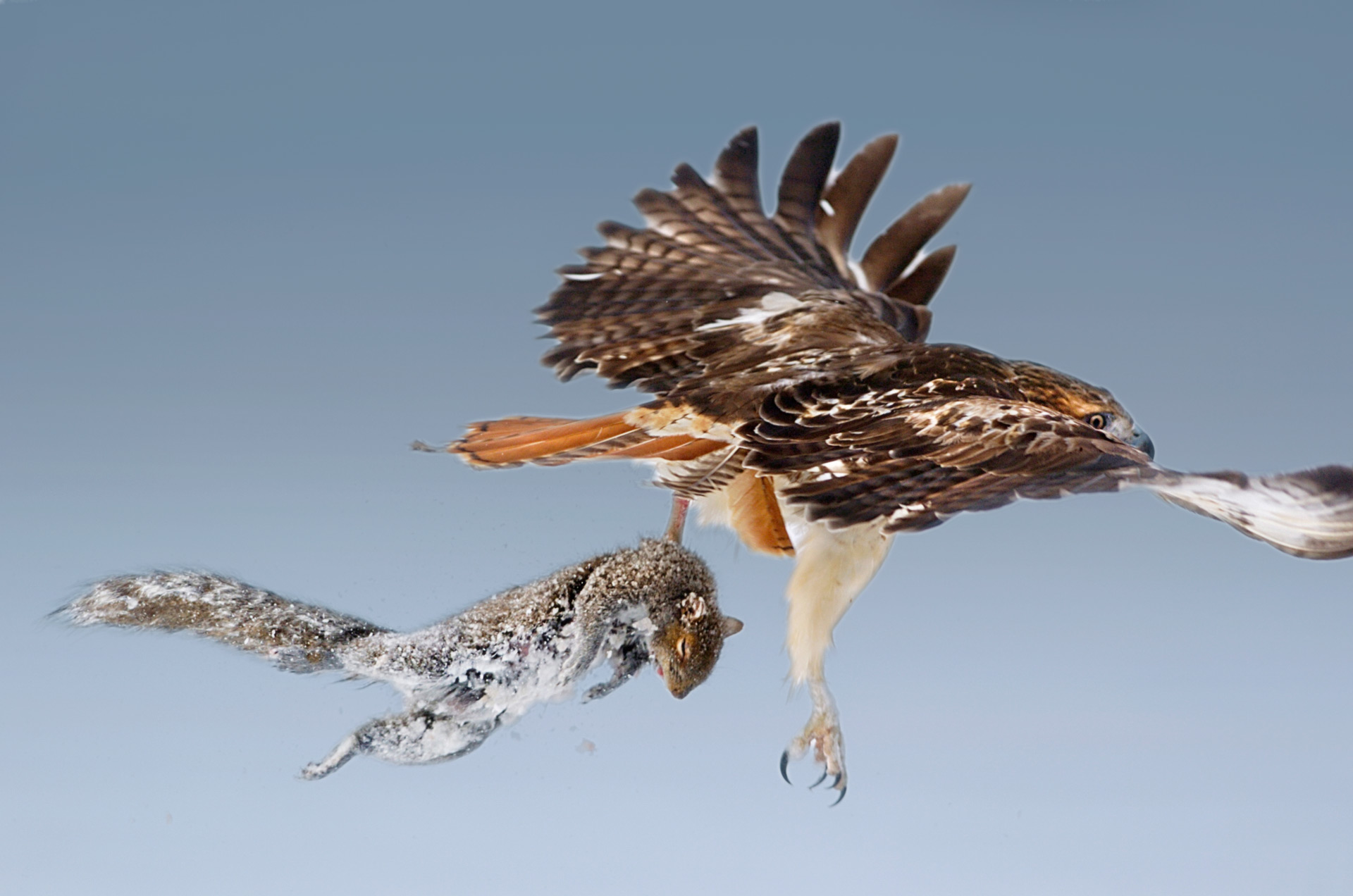
But then without warning, a shadow formed overhead in the clear sky and giggles were interrupted by a high-pitched screech as a huge hawk came soaring in from behind our little crowd, right over our heads, and into the tree line ahead of us. Dangling from its talons was the lifeless body of an unfortunate baby squirrel.
Our grandchildren have experienced enough of nature to not have been too traumatized by the incident, but it was a sobering realization of nature’s cruelty. And that’s the thing. Ever since Adam and Eve’s sin in the garden of Eden, all of nature has been cursed (Genesis 3) – humans, animals, even the ground. In his riveting testimony, David Ridgway tells about his experience of nearly dying from COVID. (Read Dave’s article.) When he was placed on the ventilator and given mind-altering hallucinogens, he experienced the sensation of being taken up into the sky, overlooking the earth. He could see how lost and full of sin mankind is. He saw “any and every kind of sin … even down to the animal kingdom,” with animals preying on each other.
Unfortunately, some people don’t grasp just how cruel “nature” can be. They think that if something is “natural,” it must also be good. (Think of sex without any boundaries.) They feel that people committing acts that used to be considered sinful are just acting in line with the way nature made them. In this sense they may even feel that they are “kinder” than God because they wouldn’t condemn someone for acting out on their base instincts.
And yet, a look at our current world overwhelmingly shows us that a person’s “nature,” a person’s natural tendencies, most certainly does lead them to sin. As adorable as they may look, even “innocent” babies are sinful creatures. They don’t naturally do the right thing. They must be taught to be kind and loving. They must be taught to control their emotions, to not lash out at everyone who bothers them. They must be taught self-control, to not give in to every desire that overtakes them.
As for feeling that they are “kinder” than God, only a depraved individual would want to leave another human being enslaved to sin. Sin, no matter how harmless it seems in the beginning, eventually leads to death. Always. Look at the homeless drug addict. Look at the person whose greed has cost them their family. Look at the man or woman who is never physically satisfied because they are held hostage by lust. Look at the elderly woman consumed by bitterness.
Thankfully Jesus Christ came to set us free from the bondage of sin.
If we claim we have no sin, we are only fooling ourselves and not living in the truth. But if we confess our sins to him, he is faithful and just to forgive us our sins and to cleanse us from all wickedness.”
1 John 1:8-9
For this reason, we can look forward to a time when sin will be annihilated once for all. Nature will be set free from its curse. The “wolf will live with the lamb,” not prey on him (Isaiah 11:6-9)! Until that day, let’s do our part to let people know they too can be set free from nature’s curse.






Several years ago, I had an enlightening moment with my dental hygienist. During the course of my health history interview, Christy, to whom I was a new patient, gradually pulled out the previous seven years of my life story. “So, you moved to L.A. after having your first son, then when you were pregnant with twins you moved here to Spokane?”
“Ugnnnhhh,” I assented around her gloved fingers in my mouth.
“Wow, twins, no wonder you haven’t had time for regular dental checkups,” she said.
(Sure, that’s the reason . . .)
“So, then it was two years after having twins that you found out your daughter was diabetic?” She removed her hands and awaited my reply.
“Uh-huh . . . and then this past year is when I had my back surgery,” I said with a cringe, knowing how dramatic those years of my life sounded on paper.
“Wow,” she said as she stuck the X-ray machine in my mouth, “you guys have really had a cool life.”
What a gift life is. In every bit of its messy glory, life is nothing less than a gift, a kiss on the brow from the Father who adores us. I am learning, ever so slowly, not to wish away the chapters of my story that I didn’t write. I’m learning, as my high school English teacher taught me, never to erase because you never know what can come from the sentences in your story that seem undesirable at first glance.
… every time I’ve broken
through discomfort, there’s been
a glory-soaked moment on the other side.
I’ve come to realize that many of the most meaningful stories are ones their authors never would have chosen for themselves. That truth echoes throughout this issue of Message of the Open Bible, where story after story reveals God’s beautiful work through circumstances that were anything but easy. If I had erased all the sentences in my own story that caused me discomfort, I would have nothing of consequence left; my life would be a stack of blank sheets of paper. Every uncomfortable moment led to a revelation of reality: who I really was, who God really was, what life was really about.
I’m learning to press into moments of discomfort instead of run from them, and here’s why: every time I’ve broken through discomfort, there’s been a glory-soaked moment on the other side. The fire, the waves, the wind — they’re all worth it, and we can pass through them knowing that God is both with us and waiting for us on the other side.
“And now, isn’t it wonderful all the ways in which this distress has goaded you closer to God? You’re more alive, more concerned, more sensitive, more reverent, more human…” (2 Corinthians 7:11 MSG).
We become more human, more fully ourselves after we’ve suffered some. While suffering was never part of God’s original design, He nevertheless uses it to restore us to His original design for us. As suffering draws us closer to Him, we begin to look more like the person He made us to be. Isn’t it incredible that to become “more human” means, in the truest sense, to become more like God? After all, humans were originally created in His image (Genesis 1:26). There could be no greater privilege, no sweeter gift.
We become more human, more fully ourselves after we’ve suffered some.
There is a passage in C.S. Lewis’s The Magician’s Nephew when Aslan the lion (the God-character in the story) has just brought to life all of creation, including the formerly “Dumb Beasts” of the land. Once everyone and everything has been awakened to new life, Aslan says something remarkable: “Creatures, I give you yourselves” (p. 118). This line, which incidentally makes me cry every single time, captures it all: our real, God-designed selves were given to us as a gift. Like Aslan, God crafts our lives and presents them to us unapologetically, fully certain of their worth and sufficiency. If He is so certain of this gift’s value, then I pray to be also.
Aslan reminds his creatures of the shells they came from, cautioning them not to return to those shells, not to forsake the vibrant and authentic life he has blessed them with. Aslan’s reminder has become my prayer. The real life God has gifted me with is worth everything I passed through to obtain it, and I never want to give it up. May I never return to the shell from which I came.
Here, then, is my life, infused with suffering and joy, kissed by God. This is my story, and I refuse to despise it.
About the Author

Hannah Bemis currently serves as the editor and director of Message of the Open Bible. She always wanted to do too many things when she grew up, and God has been kind enough to let her do most of them in different seasons. After seasons of mothering, teaching, writing, and staff pastoring, Hannah’s most recent adventure is planting and pastoring College Street Church in Newberg, Oregon, with her husband, Jordan. After Jesus and all her favorite people, she spends the remainder of her passion on pizza and dark chocolate in equal measure.

Want some Easter grass? Tiny hands held out bright green plastic grass as a gesture of friendship from the four-year-old South Korean girl, who I later learned was named Sammy. Sammy became one of my earliest friends and was architect of one of my earliest Easter memories.
To be honest, the Easter memories from the first half of my life revolve more around Easter grass, brightly colored candy-filled eggs, and straw Easter hats than they do the resurrection of Jesus.
To be honest, the Easter memories from the first half of my life revolve more around Easter grass, brightly colored candy-filled eggs, and straw Easter hats than they do the resurrection of Jesus. Easter was my mom’s favorite holiday, and we had several traditions. After buying and wearing a special Easter church outfit, we would eat out at a nice restaurant before our annual Easter basket search commenced. Instead of hiding individual eggs, my parents would hide the entire pre-filled basket. My siblings and I have formative memories of searching for hidden Easter baskets, which my father would hide in progressively more difficult places each year of my life. One of the four siblings would inevitably end up weeping because the hiding place was just too hard and it was so unfair. Ahhh, Easter.


A few of Hannah’s favorite Easter memories with family and friends.
It wasn’t until college that I began to grasp the weight and holiness of this time of year. I remember attending a sunrise Easter service and sensing the presence of God in a way that brought tears of gratitude to my eyes; He was alive and He was right here with me. Another memory involves attending a Serbian Orthodox Good Friday service as a college class assignment. The service was an all-night candlelight vigil. At scheduled times, we marched around the perimeter of the church while speaking liturgies about how Christ had “trampled death by death.” This was my first time sitting in the darkness (literally!) of Christ’s death.
This deeper internalization of both Christ’s death and resurrection stayed with me throughout my adult years. Easter became one of my own favorite holidays as I hid my own children’s Easter baskets while also making space to sit with what Christ had done for me.
… the responsibility of Easter has at times overshadowed its holiness.
And then I became a pastor. One might assume that serving as a spiritual leader would make this holy holiday feel even holier—that my anointing would allow me to experience Easter in a more present, rich way. Maybe this is true for some pastors. For me, the responsibility of Easter has at times overshadowed its holiness. There have been holy and joyful moments, such as experiencing Christ powerfully while leading an Easter worship set or the time I watched my husband dance in a bunny suit in children’s ministry. But there have been many more moments driven by the pressure to perform: to hit the harmonies just right, to fill 1,000 more eggs, to think of a really creative service opener, and to find the perfect outfit, not because it’s fun but because it’s EASTER and first impressions matter.
I know in my head what Easter is all about. I’ve experienced Christ’s death and resurrection. But the ability to experience the truth of Easter while also planning the event of Easter has proven elusive. The struggle has been about as frustrating as looking for an Easter basket that is hidden just a little too well.
“Do not be afraid, for I know that you are looking for Jesus, who was crucified. He is not here; he is risen, just as he said” (Matt 28:5-6).
I forget that Easter began with a search for Jesus. His resurrection was the onset of a search for His
presence …
I forget that Easter began with a search for Jesus. His resurrection was the onset of a search for His presence, a search that continued for the remainder of His disciples’ lives. He would pop in for a long walk or a fish breakfast, then would recede for a while. He would come as blinding light or in a dream, then recede again. While it is true that many of our traditions (both secular and Christian) can get in the way of experiencing Jesus, it is also true that much of life is a search for His presence—and sometimes the search is the point.
And there is always the promise of finding Him.
“He has risen from the dead and is going ahead of you into Galilee. There you will see him” (28:7).
You will see Him. Whether you are a mother filling eggs with candy for your kids, a college student internalizing your faith for the first time, a ministry leader feeling exhausted, or a pastor preparing a special service for twenty or 200 people, you will see Him. And maybe, as we relax into the truth of this promise, we can also remember that if He intends to make Himself known to us, He will do the same for those we love and lead. Maybe we can take some of the pressure off Easter, trusting that His promise of presence will hold true no matter how we choose to celebrate. As you prepare for and celebrate Christ’s resurrection this season, I hope you’ll enjoy the articles in this issue. We have stories about how Jesus is moving in new ways: in Africa, in a West Coast church plant, and in a Florida Next Gen leader with a huge heart for missions. God is also moving through old, rich traditions, as you’ll discover in this story. As you read, take a moment to recognize the familiar presence of God in each story. You will see Him!
About the Author

Hannah Bemis currently serves as the editor and director of Message of the Open Bible. She always wanted to do too many things when she grew up, and God has been kind enough to let her do most of them in different seasons. After seasons of mothering, teaching, writing, and staff pastoring, Hannah’s most recent adventure is planting College Street Church in Newberg, Oregon, with her husband, Jordan. After Jesus and all her favorite people, she spends the remainder of her passion on pizza and dark chocolate in equal measure.

When I was in first grade, I attended William Carey Academy, a small private school in Pasadena, California, that primarily served the children of missionaries who were on home assignment. The school was on the campus of the U.S. Center for World Mission, a collaborative mission base, which meant that I got to learn alongside students and be taught by teachers who had traveled the world. One specific perk of this season was learning Spanish. My teacher was a missionary to Guatemala who had a passion for the language and the Guatemalan people.

While most of my Spanish has left me, my love for Hispanic nations, culture, and people has not. One of the most fun parts of my job as Message editor has been working with teammates like Mindy Khanthavixay (Mexican-American), Areli Estrada (originally from Mexico), and Ximena Urra (originally from Chile) all of whom are fluent in Spanish. Without these women, it would have not been possible to launch our fully translated Spanish issues of Message of the Open Bible. As our current issue of the magazine is being released in tandem with Hispanic Heritage month (September 15 – October 15), we would be remiss not to honor our many Hispanic coworkers, pastors, and ministry partners within Open Bible. We would not be who we are without you!

Open Bible is currently active in eighteen Spanish-speaking countries and has 556 churches within these countries. Our Hispanic Ministries within the states is also flourishing with twenty-eight churches across the nation, many of which are leading the charge in church multiplication. I am so excited for you to read the story of Melissa Alvarez, who is a second-generation Mexican American and a second-generation church planter. You will also love reading the testimony of Mary Lou Wolfe, who grew up in a Hispanic Open Bible church (Templo Santo in Antioch, California) and whose parents come from Nicaragua and El Salvador. Mary Lou’s miraculous kidney transplant has made it possible for her to continue a vibrant ministry where she currently serves at Life Church in Concord, California.

In addition to these articles by Hispanic authors, don’t miss out on our other great articles, including a thoughtful reflection on modern discipleship by Gary Khan and
an important global missions update from Vince McCarty. And if you didn’t catch our special edition President’s Perspective article, you’ll want to read “The Power of We” by President Michael Nortune.
I am proud to be part of a movement that has honored and advocated for ministries in many languages, cultures, and nations. Let’s continue to celebrate every part of our Open Bible family as we fulfill the Great Commission together.
Hannah Bemis currently serves as the editor and director of Message of the Open Bible. She always wanted to do too many things when she grew up, and God has been kind enough to let her do most of them in different seasons. After seasons of mothering, teaching, writing, and staff pastoring, Hannah’s most recent adventure is planting College Street Church in Newberg, Oregon, with her husband, Jordan. After Jesus and all her favorite people, she spends the remainder of her passion on pizza and dark chocolate in equal measure.